
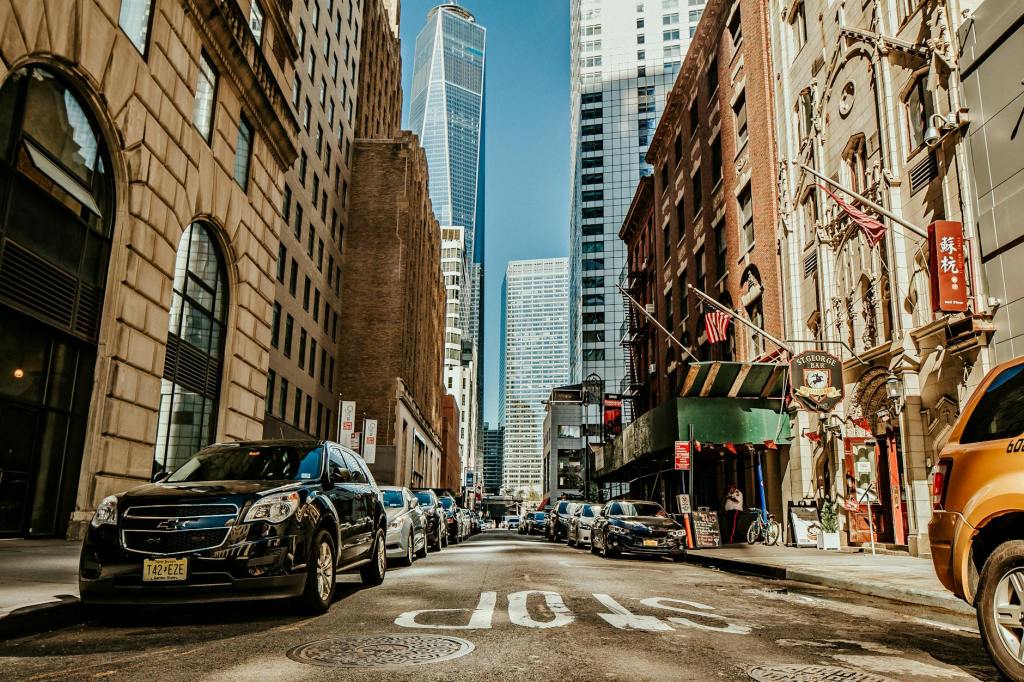
There are streets in New York that feel like they’re trying to impress you – polished corners, vague art installations, overpriced cafés holding on for dear life. And then there’s West 47th Street between Fifth and Sixth, which has absolutely zero interest in impressing anyone. The Diamond District doesn’t posture. Doesn’t pose. It just exists – loud, unapologetic, and stubbornly real. A block that feels like it’s been negotiating deals since before the city learned to speak in skyscrapers.
Stepping Into the Block: Controlled Chaos With Purpose
Approach the street from Sixth Avenue, and the energy hits before the storefronts do. People aren’t strolling; they’re moving with intention. The dealers outside storefronts, sometimes leaning on doorframes, sometimes pacing, aren’t loitering. They’re scanning for possibility. Every person walking past has the potential to be a customer, a colleague, a competitor, or someone who “knows a guy who knows a guy.”
You’ll hear a dealer on the sidewalk call out, “Buying! Selling! Trading! What you got?”. And the next guy echoes him with a different rhythm, like an accidental remix.
This is the Diamond District’s charm: everything looks improvised, but the entire ecosystem is running on decades of internal logic.
A History That Doesn’t Need Gloss
Most people don’t realize the Diamond District is a post-war creation. After World War II, Jewish diamond merchants relocated from downtown to midtown, building a new hub almost overnight. But their pasts weren’t erased – they were embedded into the block’s DNA. Generations of family businesses grew from those early days, and you can still feel the lineage in the way deals are discussed.
And it’s not just one community anymore. Over time, the block became a global intersection. You’ll find Armenian dealers, Indian families, Israeli traders, African jewelers, Russian specialists, Dominican watch sellers – all operating on the same stretch of pavement, often in the same building. It’s a living, breathing cross-cultural negotiation table where heritage isn’t side décor; it’s part of the process.
Inside the Shops: The Glow of Fluorescent Hustle
Walk inside one of the jewelry exchanges and the temperature shifts – literally and metaphorically. Those fluorescent lights have a way of making diamonds look like they’re auditioning for a movie. Glass counters everywhere. Velvet trays. Magnifying loupes. Quick, sharp movements. Someone laughing in the corner. Someone arguing in another. A man quietly placing a stone on a scale, adjusting the weight with a delicacy that feels almost ceremonial.
Every booth inside these exchanges has a story. Half of them look like they’ve been operating since the 1980s, down to the carpet color. Yet deals worth six figures happen under those flickering lights without hesitation.

The Watch Scene: Fast Hands, Faster Deals
And then there’s the watches, the whole subculture that has grown so intensely on 47th Street it practically deserves its own zip code.
Daytonas, Royal Oaks, Submariners, Cartier Crash pieces, iced-out frankens, vintage Pepsi GMTs with real patina and fake stories, Patek Nautilus references that move hands more times in a day than their owners do.
The watch world on this block is part traditional, part gray-market, part street-savvy commerce. And everyone seems to be playing the game at expert level.
Backpack dealers weaving through storefronts with quiet confidence.
Flippers checking group chats while negotiating.
Collectors passing through just to “see what’s good today.”
Dealers calling out references like sports stats.
And the conversations is where the real entertainment is.
“Steel’s down right now.”
“Gold’s creeping back up.”
“Hype pieces slowing.”
“Vintage is steady.”
“Got a buyer for that AP if you want to move it today.”
“I can move it right now, but don’t bring me that price.”
It feels like a live commodities exchange, except everyone’s wearing something worth negotiating over.
The thing about watch culture on 47th Street is that it’s not just commerce – it’s adrenaline. A collector might wait months to find a specific reference, only to have it appear in a small booth between two people arguing about a diamond bracelet. The unpredictability is part of the appeal.

Deals That Happen Like Handshakes
A funny thing about this block: deals often happen faster than introductions.
Someone walks in, asks a price, asks another, compares, hesitates, and suddenly someone from three booths away yells, “I’ll beat it!” A few seconds later, the deal is sealed.
You’ll see a man buy an engagement ring in under five minutes.
You’ll see someone sell a Rolex in less than two.
You’ll see someone lose a deal because they blinked too slow.
It’s capitalism in its purest, rawest form.
But there is an underlying network of loyalty, respect, and decades-long relationships that make the whole district function. People here may be tough, but they’re consistent. Those who cheat or cut corners don’t survive long. Word travels dangerously fast.
Reputation is the real commodity.
The Grit and the Grace
It wouldn’t be honest to romanticize 47th Street without acknowledging its flaws. There are fakes. There are scams. There are beginners who get overwhelmed the second they step inside a shop. There’s pressure, impatience, confusion, all the stuff that comes with high-value transactions and high-density personalities.
But this is part of the charm.
47th Street is real in the way that luxury shopping rarely allows itself to be real anymore. No curated playlists, no minimalist décor, no fragrance diffusers trying to convince you you’re in the presence of wealth.
And that’s refreshing.
Why 47th Street Still Matters
In a world obsessed with online everything – online shopping, online authentication, online investment, online consultation – 47th Street remains human, imperfect, electric.
People still want to come here because:
- It feels like New York. The real New York.
Not curated, not polished – alive. - It’s a place where luxury isn’t pretended. It’s earned.
Sometimes loudly, sometimes quietly, but always genuinely. - The stories matter as much as the prices.
Every shop, dealer, and booth has its own mythology. - There’s a thrill to it.
A sense that something valuable might appear at any moment. - You learn quickly.
Even without trying. - You see cultures converge in a way that’s rare anywhere else.
And it works.
The Diamond District is an encyclopedia written by people who don’t have time to sit down and write anything. They’re too busy shaping the next chapter.
Closing: The Block That Doesn’t Pretend, It Just Is
For anyone who loves watches, diamonds, or just pure New York culture, there’s something magnetic about the block. Something that keeps pulling you back for one more walk, one more look, one more deal happening in the corner of your eye.
A place where everyone’s hustling, but somehow – the street itself is the one that always wins.
And if this street pulls you into the watch side of the culture, the deep dive on luxury watch investing is waiting – feels like the natural next stop.
 Vistad Media